
Writing about fabrics is so difficult. Do you go super indepth and technical, do you make it so they look at garments they already have. What if the fabrics are called different names in different countries. What if you suggest a fabric and someone tries and it doesn’t work?
This and a million more questions bombard my brain when I go to write about fabrics. So much so you’ll notice that this post is out of sequence to what I told you was going to happen in the Basic’s schedule.
So I’m breaking fabrics down and going with what feels right.
All fabrics are different and a fabric that may work perfectly for me may not work for you. Reason being is not all fabrics are created equal and we all want things to fit in a certain way. So before we even get into specific fabrics my best advice is to make your muslin/toile/sample in as close as possible fabric to your final fabric. Ideally if you can make it in the exact same fabric that would be awesome (though not always practical or affordable). If you use something with super stretch to it and make all your adjustments based on that and then the next time you use the pattern you use something with barely any stretch then there are going to be issues.
So number 1 tip – use the same or as close as possible fabric as you can for your muslin/toile/sample.
Number 2 tip – check your stretch % and mark it on your pattern so when you come back to it you can check your new fabric and see if changes need to be made. Your future self will be happy with you if you do this.
To check % I tend to grab a piece of paper and draw a 10cm square on it (hint: use the size test piece included in your pattern). I cut a 10cm square of fabric or I mark 10cm square on the fabric. Stretch the 10cm of fabric as far as you can and mark it in the paper. Do this for the height and width of the fabric square. You want to cut out with the stretchiest direction of the fabric going around your body not up and down. Measure how far over the 10cm your fabric stretched and then turn this into a %.
Number 3 tip – measure yourself, measure the actual pattern pieces (allow for seam allowances). Choose the size that suits you best taking into account the % stretch you can use from your fabric. Ideally for the Race Back Singlet you want to use a little bit of stretch but not all of the stretch. If you are using it for a super fitted or swim top then you may perhaps want to use more of the stretch but just make sure you can still breathe ok?
Once you have that you can cut out and start sewing. In order to get to this stage though we need to talk about some specific fabric choices. In the pattern I’ve suggested
Suitable for stretch knits only. Ideally for 1 x 1 Rib knits, jersey, interlocks. An Lycra/spandex/elastane content is highly recommended for a better fit. The finished garment measurements are measured without the aid of stretch so you can see you need a proper stretch fabric to ensure a good fit.
1 x 1 Rib – rib is beautiful to wear, soft and supple it gives you stretch and comfort. Look for lightweight ribs that feature a high % of cotton for a nice comfortable top. Some ribs will contain Lycra/spandex/elastane and some are finished with an elastomeric finish. This is a treatment that is added to the rib after it has been made and should be a permanent finish (meaning it’s not one that washes out).
Jersey – now this is a name that gets thrown around alot to describe almost any kind of knit fabric. I tend to use the term in the same way as Wikipedia does. A single layer of knit fabric that is most suitable for t-shirts. Jerseys can be a bit more stable than other knits so check your stretch % and measurements. I like jersey because it is stable and sometimes we don’t all want super soft clingy style fabrics. It also comes in different weights which can be super handy when building a wardrobe consisting of layering pieces.
Interlock – a softer more supple type of knit fabric. Interlock is often found in undergarments and very drapey styles of knit. This softness is wonderful to wear and play with though I can sometimes find it slightly unforgiving and prone to showing all the bumps.
With Lycra/spandex/elastane – the addition of any of this fibre will increase a fabrics stretch. The amount of Lycra added to the fabric is often given as a $ for example 95% cotton 5 % Lycra. This is not the same as stretch %, sometimes the 2 get a little mixed up.
Incorrectly some swim, dance and performance fabrics often get referred to as “Lycra”. While they may contain Lycra it’s more likely the actual fabric is a polyester/Lycra or a nylon/Lycra. This is good to know when searching online for fabrics and the terminology is different from the generic terms you may be used to using.
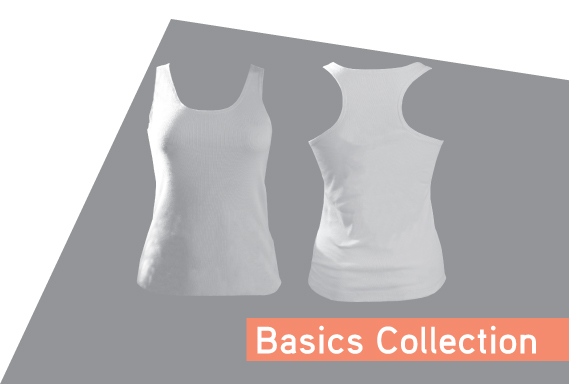
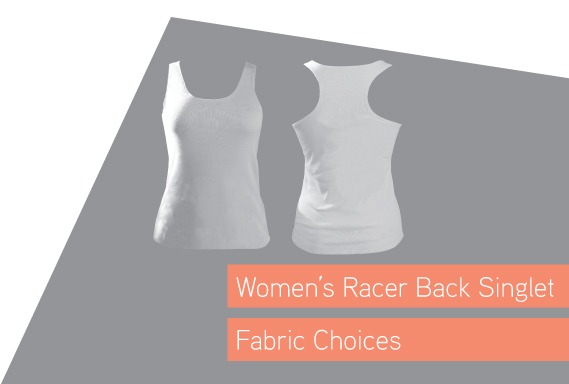
All of these fabrics would be good choices for the Racer Back Singlet and I hope you have fun experimenting with the style of fabric that suits you best.